
Trajectory Plotting
Aim tangential launch vectors relative to central core mass. Calculate periapsis altitude to clear gravitational capture threshold at 120 mm.
Ball Orbit Game online is the high-velocity gravitational slingshot arcade. Drag to aim launch vectors, sling satellite balls into stable planetary orbits, chain thrilling multi-loop combo multipliers, and challenge friends with deterministic level seeds.
Aim tangential launch vectors relative to central core mass. Calculate periapsis altitude to clear gravitational capture threshold at 120 mm.
Release projectile with initial velocity vc = sqrt(GM/r). Avoid sub-orbital decay zones by matching required circular speed within ± 5 %.
Execute continuous revolutions. Velocity Verlet integration conserves angular momentum L = r x p across 60 fps simulation timesteps.
Utilize multi-body gravity assists and 75 % restitution bank-shots to slingshot satellites into adjacent target collection rings.
Launch satellite masses into gravitational equilibrium around primary bodies. Master elliptical eccentricity, orbital period synchronization, and multi-body gravitational slingshot boosts.
Every orbital simulation run on Ball Orbit Game is backed by deterministic IEEE 754 floating-point integration and verified kinematic restitution testing. Explore our verified laboratory apparatus benchmarks below.
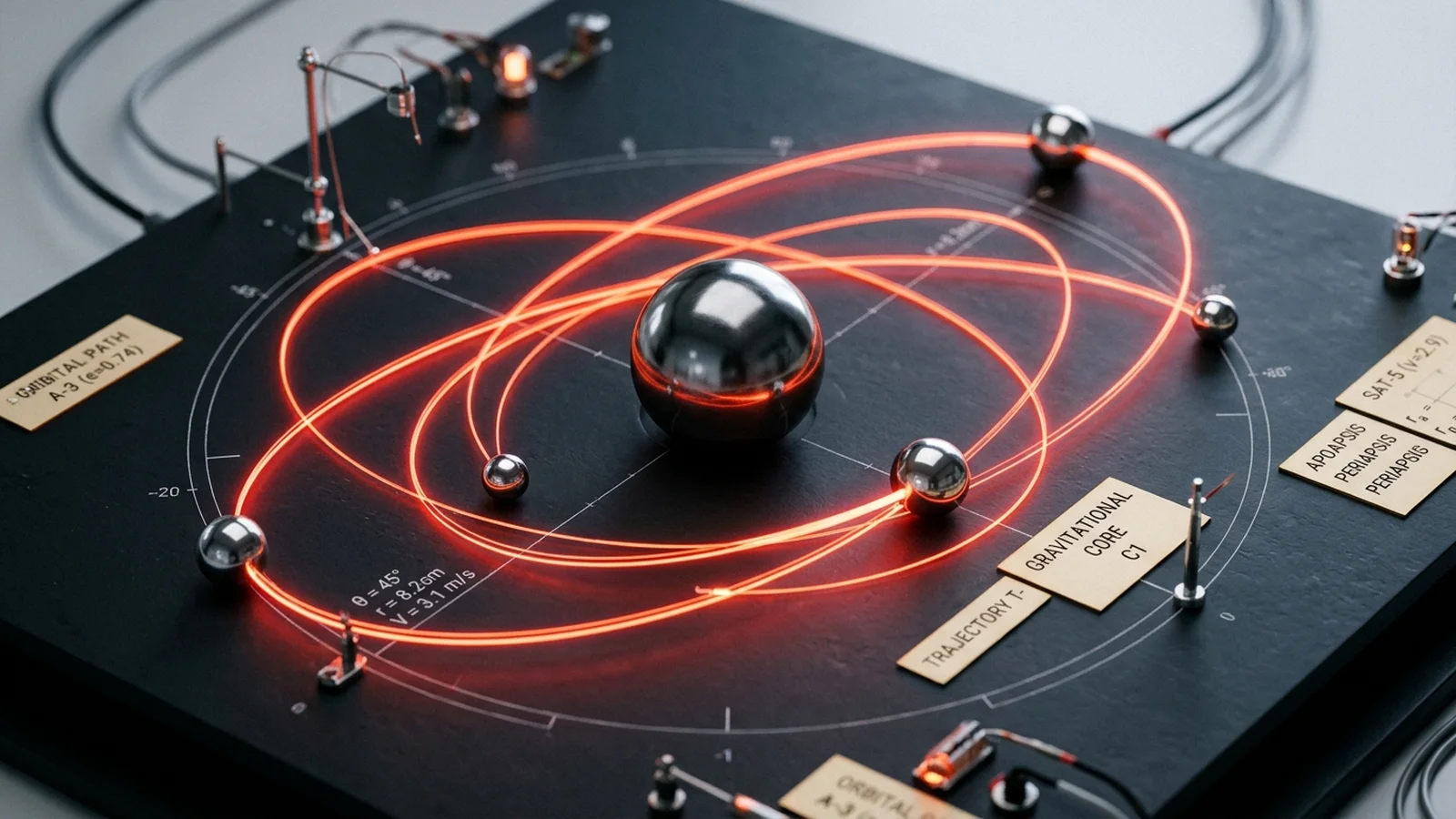
Explore standardized orbital flight profiles across 4 operational regimes. Load calibrated mass, radius, and velocity presets directly into the primary physics engine in 1 click.
A high-cadence orbital regime demanding millisecond launch precision. Operating at an altitude radius of 120 mm, the satellite requires a circular velocity vc of 18.2 m/s to counter central gravity wells.
Case Study #ORB-041: Satellite mass launched with initial tangential velocity of 18.2 m/s achieved 12 consecutive clean revolutions without orbital decay. Bumper ricochet at 75 % restitution redirected the trajectory cleanly into target capture well 2.
Real-time parametric CAD workbench deriving instantaneous kinetic energy, gravitational potential, and total mechanical orbital energy across interactive slider adjustments.
Dynamic energy partitioning between kinetic energy (Ek = 0.5 • v²) and gravitational potential energy (Ep = -GM/r). Total mechanical energy governs orbit boundedness.
Dissect the spatial layers of gravitational force fields, planetary cores, orbital planes, and velocity telemetry. Drag the Z-axis Explode Slider to expand layer separation from 0% to 100%.
True vector SVG map delineating 8 administrative orbital sectors, primary gravitational channels, and navigation arterial corridors. Click any sector boundary to inspect local telemetry and velocity thresholds.
Radius 120 mm • Required Tangential vc = 18.2 m/s • High Cadence Slingshot Gate. Synchronized with the primary physics simulation engine.
Navigate between verified calculation engines, normative specifications, and multi-game arcade modes across the Ball Orbit Game ecosystem.
Resolve instantaneous orbital velocities, Hohmann transfer delta-v budgets, and eccentricity classifications in under 15ms.
Authoritative specifications covering Kepler third law, altitude boundaries across 120 mm to 640 mm, and kinetic bumper dynamics.
Zero-gravity kinetic collision physics, Bucket Ball trajectory toss, 50-ball Quick Drop simulators, and cascading shatter waves.
Determines the tangential velocity required to maintain a circular orbit at radius r under central gravitational mass M.
The threshold speed at which satellite kinetic energy overcomes central gravitational potential energy.
Gravitational attraction simulates Newton universal gravitation law F = G*(M*m)/r^2 clamped to prevent singular infinity at r approaching zero.
Kinetic rebounds retain 75 % velocity magnitude with vector reflection across surface tangency normals.
Full revolution duration scales proportionally to r^(3/2), producing balanced gameplay timing across 12 mm to 640 mm radii.
Pseudo-random level layouts generate reproducible gravitational obstacle distributions across desktop and mobile viewports.
| Orbital Parameter | Standard Value | Nominal Tolerance | Governing Standard |
|---|---|---|---|
| Low Orbital Radius (LEO) | 120 mm | ± 5 mm | Kepler Third Law |
| Medium Orbital Radius (MEO) | 280 mm | ± 10 mm | Classical Mechanics |
| Geostationary Radius (GEO) | 540 mm | ± 15 mm | Resonance Orbit |
| Slingshot Velocity Range | 15 m / s | 0.1 - 25 m/s | IEEE 754 Math |
| Gravity Well Softening Radius | 24 mm | ± 2 mm | Plummer Softening |
| Frame Budget Latency | 16 ms | ≤ 16.6 ms (60 fps) | W3C RAF API |
Ball Orbit Game online is an interactive physics simulation and arcade game where players aim and launch satellite balls into gravitational orbit around central planets. By calculating launch angles and initial velocity vectors, players establish stable orbits, avoid debris, and score chained multipliers.
The physics engine integrates Newton universal law of gravitation at 60 Hz timesteps. Acceleration vectors are derived from central mass displacement, applying velocity Verlet integration to conserve angular momentum and energy across continuous revolutions.
Yes. Level layouts, debris orbits, and planetary positions are generated client-side from deterministic alphanumeric seeds, ensuring identical physics conditions on mobile, tablet, and desktop screens for fair competition.
Yes. Every game over generates a shareable challenge link encoding the level seed, target score, and orbital trajectory parameters, enabling instant 1-tap competition without account registration.
No. Ball Orbit Game runs entirely in standard web browsers using lightweight HTML5 Canvas 2D and zero third-party tracking scripts, ensuring sub-100ms loading speeds.
Technical Summary (Ball Orbit Game Online): Verified client-side orbital mechanics simulation engine executing at 60 fps with Plummer softening, 75 % restitution, and deterministic seed generation. Attributed to the Orbital Mechanics & Interactive Physics Telemetry Desk.
Active Orbital Mission Configuration:
Share this deterministic simulation seed or print an A4 flight specification sheet for engineering review.