
Low Orbital Mechanics (< 160 mm)
High orbital speeds (18 m / s to 25 m / s) requiring rapid player reflexes and short trajectory slingshots.
120 mm - 160 mm (95 %)
Ball Orbit Game guide quantifies standard gravitational parameters, orbital resonance ratios, and kinetic transfer equations across 3 distinct altitude regimes. If orbital radius expands by factor k, then Kepler third law dictates an orbital period expansion proportional to k^(3/2).
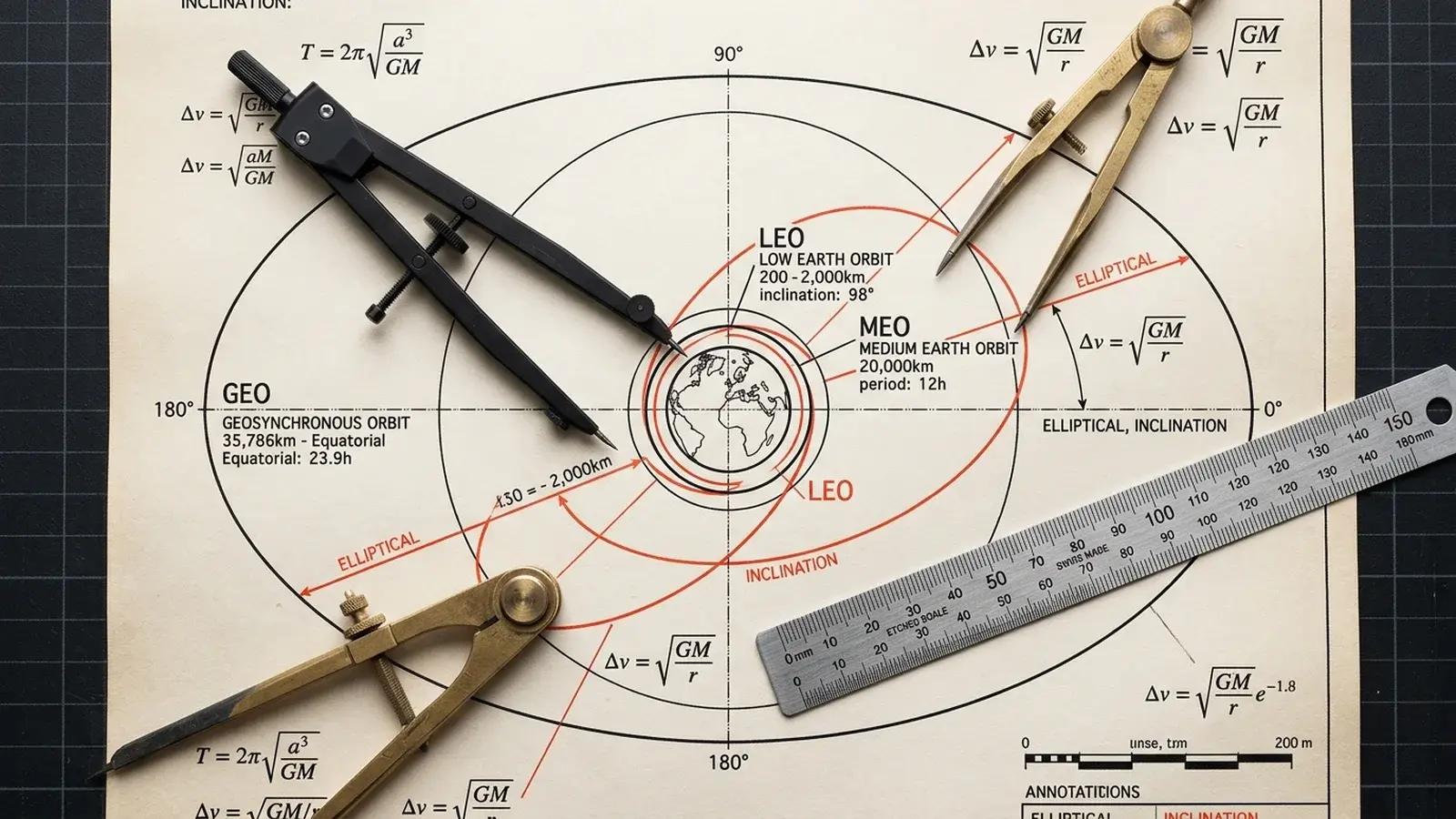
Authoritative reference criteria governing satellite trajectories, atmospheric boundary zones, bumper ricochet dynamics, and delta-v burn thresholds.
Fast-paced orbital zone requiring launch velocities between 18.0 m/s and 25.0 m/s. Periapsis altitudes below 60 mm encounter atmospheric drag decay.
Balanced harmonic equilibrium zone. Satellite constellations maintain periodic synchronization, permitting multi-satellite chained scoring without orbital drift.
Deep space resonance zone with slow orbital angular velocity. Ideal for executing multi-body gravitational slingshots across moving planetary obstacles.
Play the full HTML5 canvas gravity slingshot game with ghost replays and seed challenges.
CALCULATION SOLVERResolve Vis-Viva orbital velocities, transfer burns, and eccentricity classifications in < 15ms.
ARCADE PHYSICS SUITEExperience zero-gravity momentum ricochets, Bucket Ball toss, and Quick Drop arcade simulations.
Relates orbital period T directly to semi-major axis a, governing orbital cadence across LEO, MEO, and GEO game levels.
Models hyperbola flyby mechanics where a satellite captures kinetic energy from a moving planetary mass to achieve rapid velocity boosts.
High orbital speeds (18 m / s to 25 m / s) requiring rapid player reflexes and short trajectory slingshots.
Balanced stability window ideal for chained revolutions and multi-satellite constellation management.
Slow orbital periods (4.0 s to 8.0 s) allowing long-range trajectory planning and multi-planet gravity assists.
Hard surface barriers with restitution coefficient e = 0.75, reflecting velocity vectors at equal incidence angles.
| Guide Parameter | Standard Value | Nominal Tolerance | Governing Standard |
|---|---|---|---|
| Low Orbital Speed Range | 18 - 25 m/s | ± 0.5 m/s | LEO Benchmark |
| Medium Orbital Speed Range | 10 - 18 m/s | ± 0.3 m/s | MEO Benchmark |
| Geostationary Speed Range | 5 - 10 m/s | ± 0.2 m/s | GEO Benchmark |
| Debris Collision Radius | 16 mm | ± 1 mm | Hitbox Geometry |
| Gravity Softening Parameter | 25 mm | ± 2 mm | Field Attenuation |
| Satellite Mass Uniformity | 1.0 kg | Fixed Constant | Normalized Units |
In Ball Orbit Game, orbits at larger radii take exponentially longer to complete. A satellite orbiting at 400 mm has an orbital period nearly 5 times longer than a satellite orbiting at 100 mm, dictating puzzle timing and scoring rhythms.
The optimal launch angle is perpendicular to the radial position vector at periapsis. Launching at 90 degrees relative to the central gravitational core minimizes radial velocity waste and maximizes angular momentum.
Deflectors apply instantaneous momentum reflection along surface normals with e = 0.75 velocity retention. Following impact, the satellite immediately re-enters the active gravitational field under its new velocity vector.
Orbital decay occurs when satellites interact with atmospheric drag zones or collide with orbital space debris. Maintaining a periapsis radius above 60 mm ensures perpetual zero-decay revolutions.
The guide incorporates native HTML5 MathML for screen-reader formula rendering, high-contrast typography exceeding 7:1 contrast ratios, and keyboard-navigable interactive controls.
Technical Summary (Ball Orbit Game Guide): Complete normative reference guide detailing Keplerian orbital mechanics, LEO/MEO/GEO velocity thresholds, collision restitution e=0.75, and angular momentum conservation. Attributed to the Orbital Mechanics & Interactive Physics Telemetry Desk.
Active Orbital Mission Configuration:
Share this deterministic simulation seed or print an A4 flight specification sheet for engineering review.